Understanding the value of scalability, simplified expansion, and modern deployment flexibility.
For many engineering teams, an HMI project starts with a simple question: how many tags and clients do we need today?
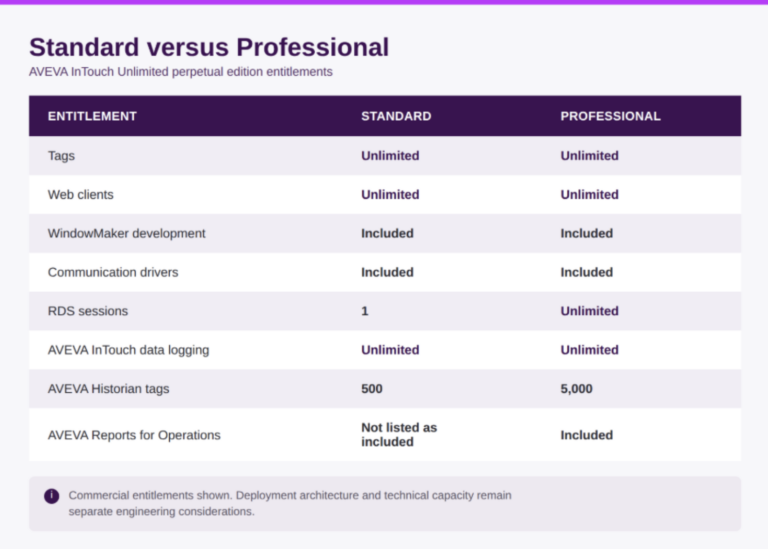
AVEVA InTouch Unlimited changes part of this discussion. InTouch Unlimited Standard and Professional include unlimited tags and unlimited web clients. RDS sessions, AVEVA Historian capacity, reporting and deployment entitlements vary by edition and commercial model. This allows teams to move purchased tag-count tiers out of the main design discussion while still selecting the edition and architecture that fit the deployment.
The problem is that industrial projects rarely stay the same.
A small application may begin with one production line, a limited number of tags, and a few operator stations. Later, the business may add more equipment, more users, remote access, additional reporting or another site. At that point, the original licensing and architecture decisions can become a constraint.
Unlimited is not only about tag count
The most obvious commercial change is the removal of purchased tag-count tiers.
With AVEVA InTouch Unlimited, tag count is no longer a purchased package tier. Technical performance, application quality and maintainability still depend on the system architecture and engineering design.
When teams are working within a purchased tag tier, capacity considerations can influence early design decisions or require repeated checks as the application grows. Removing the purchased tag tier allows the tag structure to be based more directly on the operational requirement, while disciplined tag engineering remains essential.
This does not mean that every project should include unnecessary tags. Good tag design is still important. Naming, structure, data quality, scan rates, alarm configuration, Historian load and maintenance all remain engineering responsibilities.
Easier expansion when the project grows
Project growth is not always predictable. You may need to add:
- Additional web users
- Dedicated operator workstations
- RDS access
- Engineering or maintenance environments
- Reporting and historical-data requirements
- Additional production areas or locations
Both perpetual editions include WindowMaker development, communication drivers, unlimited tags and unlimited web clients. RDS, Historian and reporting entitlements differ: Standard includes one RDS session and 500 Historian tags, while Professional includes unlimited RDS sessions, 5,000 Historian tags and AVEVA Reports for Operations.
Both editions also include situational-awareness graphics, web widgets and unlimited InTouch data logging.
With tiered or separately licensed components, an expansion can trigger additional commercial and architecture review. For engineering teams, this can make expansion easier to plan.
Teams may spend less time revisiting purchased tag tiers and web-client capacity. RDS sessions, Historian requirements, reporting, deployment rights and technical architecture still need to be reviewed as the project develops. The review may include tag tiers, client types, RDS sessions, Historian capacity, reporting and deployment entitlements.
Understanding what ‘unlimited web clients’ means
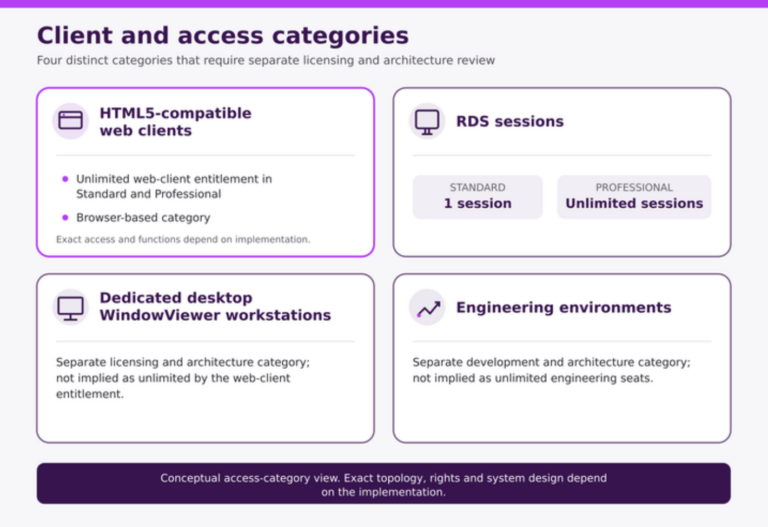
The current AVEVA comparison lists unlimited web clients for AVEVA InTouch Unlimited Standard and Professional. However, Remote Desktop Services sessions differ by edition. Standard includes one RDS session, while Professional includes unlimited RDS sessions.
This entitlement should not be interpreted as unlimited standalone desktop WindowViewer workstations or unlimited engineering seats. Web clients, RDS sessions, dedicated operator workstations and engineering environments are different licensing and architectural categories.
During project design, an engineering team should still ask:
- Will users connect through an HTML5-compatible web client?
- Are dedicated operator workstations required?
- Will the application use Remote Desktop Services?
- Are users local, remote or distributed between sites?
- Which functions should be available to each type of user?
Unlimited web-client entitlement can simplify one part of commercial planning, but the access architecture must still match the operational use case. A browser-based user checking a process overview has different requirements from an operator running a critical control-room workstation.
Simpler licensing can reduce project uncertainty
Licensing is often treated as a purchasing topic, but it can directly affect engineering work. With tiered or separately licensed components, teams need to confirm that the required client types, RDS sessions, Historian capacity, reporting, communication and deployment entitlements have been addressed.
If these requirements are not confirmed early, the team may need to revisit scope, architecture or commercial assumptions later in the project.
AVEVA InTouch Unlimited reduces licensing uncertainty by packaging core development and communication capabilities together. Both perpetual editions include WindowMaker development and communication drivers, including OPC UA and MQTT, but edition-specific RDS, Historian, reporting and deployment requirements must still be confirmed.
It also supports a more consistent reference architecture across similar machines or production lines. Reuse across separate sites still requires confirmation of deployment rights, commercial coverage and the architecture required for each site.
Modern engineering and deployment options
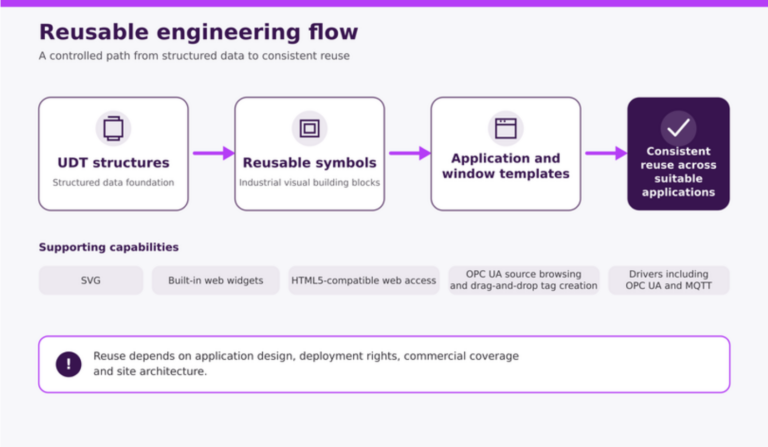
The value of AVEVA InTouch Unlimited is not limited to licensing. Powerful capabilities include user-defined type structures, reusable industrial symbols, application templates, SVG support, built-in web widgets, HTML5 access, and OPC UA connectivity with source browsing and drag-and-drop tag-creation workflows.
This can support:
- Consistency across applications
- Structured reuse
- Change management
- Repeatable testing
- Maintainability
- Improved engineering consistency and efficiency
For engineering teams, UDT structures, reusable symbols and templates can support a more standardized development approach. Instead of building similar equipment or production units separately, a team can apply structured reuse where the application design supports it.
AVEVA InTouch Unlimited also supports browser-based access through HTML5-compatible web clients.
Wider access must still be designed carefully, which is why user roles, cybersecurity, network zones, remote-access policy and control permissions remain part of the system architecture.
Scalability still requires engineering discipline
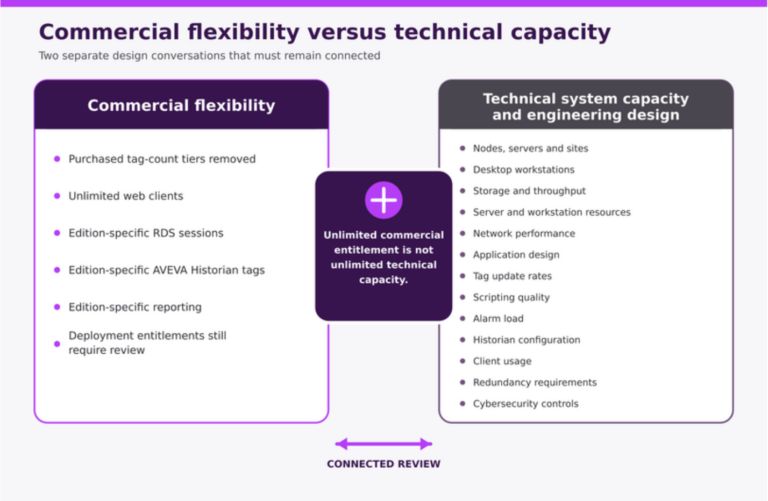
Unlimited commercial entitlement should not be read as unlimited nodes, servers, sites, desktop workstations, storage or throughput.
A poorly structured application does not become scalable simply because specified commercial entitlements are unlimited. Engineering teams should continue to define system boundaries, performance requirements, deployment architecture, backup strategy, redundancy and future-growth assumptions.
Every system still depends on:
- Server and workstation resources
- Network performance
- Application design
- Tag update rates
- Scripting quality
- Alarm load
- Historian configuration
- Client usage
- Redundancy requirements
- Cybersecurity controls
AVEVA InTouch Unlimited can provide more commercial flexibility around tags and web clients. Deployment topology, technical capacity and edition-specific entitlements remain part of the engineering and commercial design.
A different way to plan HMI projects
The practical shift is from asking only which tag and web-client package is needed today to asking which architecture and edition will support the operation as it develops.
This can support a more consistent engineering approach across similar production areas, while RDS, Historian, reporting and deployment entitlements still need to be confirmed.
Instead of asking, ‘How many tags and clients can we afford today?’ the team can ask, ‘What architecture, access model and data requirements will support the operation today and its expected growth?’
Questions engineering teams should ask
- Which users need standalone desktop WindowViewer, browser-based web-client or RDS access?
- Does the deployment require one RDS session or multiple RDS sessions?
- Which data should use AVEVA InTouch data logging, and how many tags require AVEVA Historian?
- Is AVEVA Reports for Operations required, and has the selected edition been checked against that requirement?
- Will the project use one node or a multi-node architecture?
- Is browser-based remote access part of the requirement?
- Will UDT structures, reusable symbols and templates be reused across projects?
- For reuse across separate sites, have deployment rights, commercial coverage and the required architecture been confirmed?
- Which communication drivers and protocols are required?
- Is a perpetual or subscription commercial model more suitable?
- What cybersecurity and user-access controls are required?
- What future expansion should the architecture support?
These questions remain necessary even when tags and web clients carry unlimited commercial entitlements.
Conclusion
AVEVA InTouch Unlimited changes the starting point for HMI engineering.
It removes purchased tag-count tiers from the main design discussion, includes unlimited web clients, and packages core development and communication capabilities together. The selected edition still determines RDS, Historian, reporting and deployment entitlements.
The value is not an absence of limits. It is the ability to focus more of the early design discussion on operational requirements, reusable engineering, access architecture and expected growth, while maintaining disciplined technical and commercial review.
For projects expected to evolve, this can make expansion easier to plan and support a more consistent engineering approach.