Selecting a SCADA system isn’t just a technical decision; it’s a long-term operational choice that directly impacts efficiency, visibility, and scalability across your business.
With SCADA solutions tailored to industries such as power utilities, water treatment, oil & gas, manufacturing, and food & beverage, the challenge isn’t finding a system — it’s choosing the right one.
So what actually differentiates one SCADA platform from another?
1. Start with the Scale of Your Operations
Not all SCADA systems are built to handle the same size or complexity.
Some are designed for small, standalone applications, while others are engineered for large, distributed environments spanning multiple sites.
Before selecting a solution, ask:
- Can this SCADA handle my current system size?
- More importantly, can it scale as my operation grows?
Choosing a system that fits today but fails tomorrow leads to costly migrations and disruptions.
2. Communication Protocols Matter More Than You Think
Industrial environments rarely operate on a single protocol.
From Modbus and OPC to industry-specific standards, your SCADA must integrate seamlessly across your existing infrastructure.
A strong SCADA platform should:
- Support a wide range of protocols out of the box
- Enable easy integration with legacy and modern systems
- Reduce the need for custom development
The more flexible the connectivity, the smoother your operations.
3. Data Is an Asset — Treat It That Way
Industrial Intelligence is one of your most valuable tools.
Your SCADA system should not only collect data, but also:
- Archive it efficiently
- Structure it for easy retrieval
- Support analysis and decision-making
Without proper data management, you’re collecting information without unlocking its value.
4. Operator Experience Drives Performance
In high-pressure environments, operators rely on clear, intuitive interfaces.
Poorly designed graphics and a lack of situational awareness principles can delay decisions and increase risk.
Key considerations:
- How easy is it to design and maintain HMI screens?
- Are there built-in libraries tailored to your industry?
- Can you create and standardize your own graphics?
A clean, consistent interface isn’t just aesthetic — it’s operationally critical.
5. Redundancy Without Complexity
Downtime is not an option in most industrial operations.
Redundancy is essential, but it shouldn’t double your workload.
The right SCADA system should:
- Support built-in redundancy
- Minimize duplication of engineering effort
- Ensure seamless failover without operator disruption
Resilience should come as part of the system, not as an added burden.
6. Future-Proofing Your Investment
Your business will evolve. Your SCADA should evolve with it.
Whether expanding sites, integrating new technologies, or increasing production, your system must adapt without requiring a complete overhaul.
Look for:
- Modular architecture
- Scalability from small to enterprise-level systems
- Compatibility with future digital transformation initiatives
7. Simplifying Training and Maintenance
Using multiple SCADA platforms across your organization creates inefficiencies.
Each system requires:
- Separate training
- Different skill sets
- Increased maintenance complexity
Standardizing on a single, flexible platform reduces overhead and strengthens your team’s capability.
A Practical Approach: AVEVA InTouch HMI
AVEVA InTouch HMI addresses these challenges with a flexible, scalable approach to industrial visualization and control.
Designed to support the full spectrum of operations — from edge-level applications and OEM equipment to client-server architectures — it enables organizations to standardize on one platform across multiple use cases.
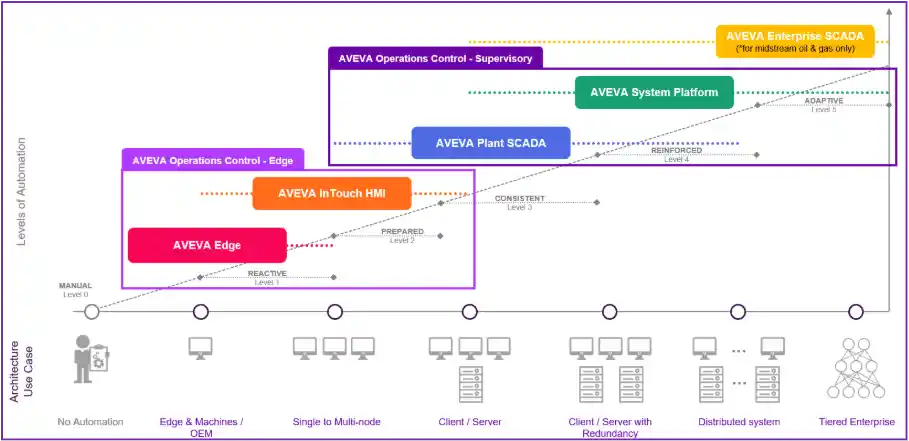
Key strengths include:
- Scalability from standalone systems to enterprise deployments
- Broad protocol support for seamless integration
- Strong data handling and visualization capabilities
- Intuitive development environment with reusable graphics
- Built-in redundancy features without duplicating effort
- A consistent platform that simplifies training and maintenance
Final Thought
Choosing a SCADA system isn’t about ticking feature boxes — it’s about aligning technology with how your operation runs today and how it will grow tomorrow.
The right platform should simplify complexity, not add to it.